
By Katie Koenig
Climate change is happening at an alarming rate, but what does that mean for the species that live on the Earth?
Polar bears are one species that the U.S. Fish & Wildlife Services (FWS) has labeled as threatened and likely to become endangered. According to the World Wildlife Fund (WWF) there are currently roughly 25,000 polar bears, but their population is projected to decline by 30% by 2050.
Polar bears rely on arctic sea ice to live, hunt, and raise their young. In an overview in the U.S. FWS’s conservation plan for polar bears, with climate change melting the ice caps, these bears are losing their habitat. It’s harder for them to find seals, which are their primary food source, so they use more energy to get to them, and it also takes more energy to reproduce.
As explained by the WWF, because of their direct reliance on the ice caps, they serve as an accurate indicator species as to the state of climate change. Essentially, the worse state the ice caps are in, the worse off polar bears are. Also in reverse, we can identify the state of the arctic based on the state of the polar bear species.
Their population is projected to decline based on the rate ice is melting in the arctic. By 2040, all summer ice areas will be gone except in Northeast Canada and Greenland. Arctic ice shrinks about 14% per decade. Between 1981 and 2010, we lost more ice than the combined size of Alaska and California.
Another aspect that threatens polar bears is industries’ increased use of the Bering Strait. Oil spills and increased traffic threaten polar bears away from this area, and threaten their lives. Because of the loss of habitat and food, bears are migrating towards human settlements, but this also increases the amount of human-bear conflict, which not only threatens human safety but also polar bears’ population.
They’ve coexisted with indigenous people for thousands of years, in fact. Polar Bears International, an organization dedicated to this species’ conservation and survival, explains that in Alaska, one such group of indigenous people are the Inupiat, or the Inuit people. A subsistence lifestyle is intrinsic to their culture and lives, so loss of sea ice and decreasing polar bear populations also impacts the Inupiat’s ability to live.
Conservation
To be brief about the history of their conservation, the U.S. FWS officially listed polar bears as threatened in 2008. In a later notice by the FWS, they were additionally categorized as marine mammals so that they received increased protections around the same time. In 2010, the FWS identified them as living in a critically endangered habitat.
However, it’s not all gloomy—in 2017, the FWS published their plan to conserve the species, although the plan focuses only on the Alaskan population, which I mentioned and linked to at the start. Their first suggestion was, of course, to reduce greenhouse gases in the atmosphere, which would slow the melting of sea ice. Another step was to coordinate efforts with other countries to manage the total polar bear population. Additionally, it’s important to actively protect their den habitats and prevent oil spills and contamination.
Polar Bear Facts
It’s great to know what we’re doing to keep the polar bear species alive, and it’s also important to know what they’re actually about!
According to the FWS’s general page on polar bears, they’re one of the largest bear species that currently lives on our planet. They’re split into nineteen total subpopulations, stretching across multiple continents. Only two of these subpopulations mingle with U.S. borders, namely the subgroup in the Chukchi Sea, and in the Southern Beaufort Sea.
I’ve added the World Wildlife Fund’s map of polar bear populations below. In the top left area, you can see Chukchi Sea in blue—indicating that population is stable—and Southern Beaufort Sea in red—meaning the population there is declining. The Bering Strait is directly in the Chukchi Sea population, between Russia and Alaska.

Map of the Arctic Basin and the nineteen subpopulations of polar bears categorized by their territory. It tracks the change in populations for each of the nineteen subgroups. Available through the WWF page on polar bears.
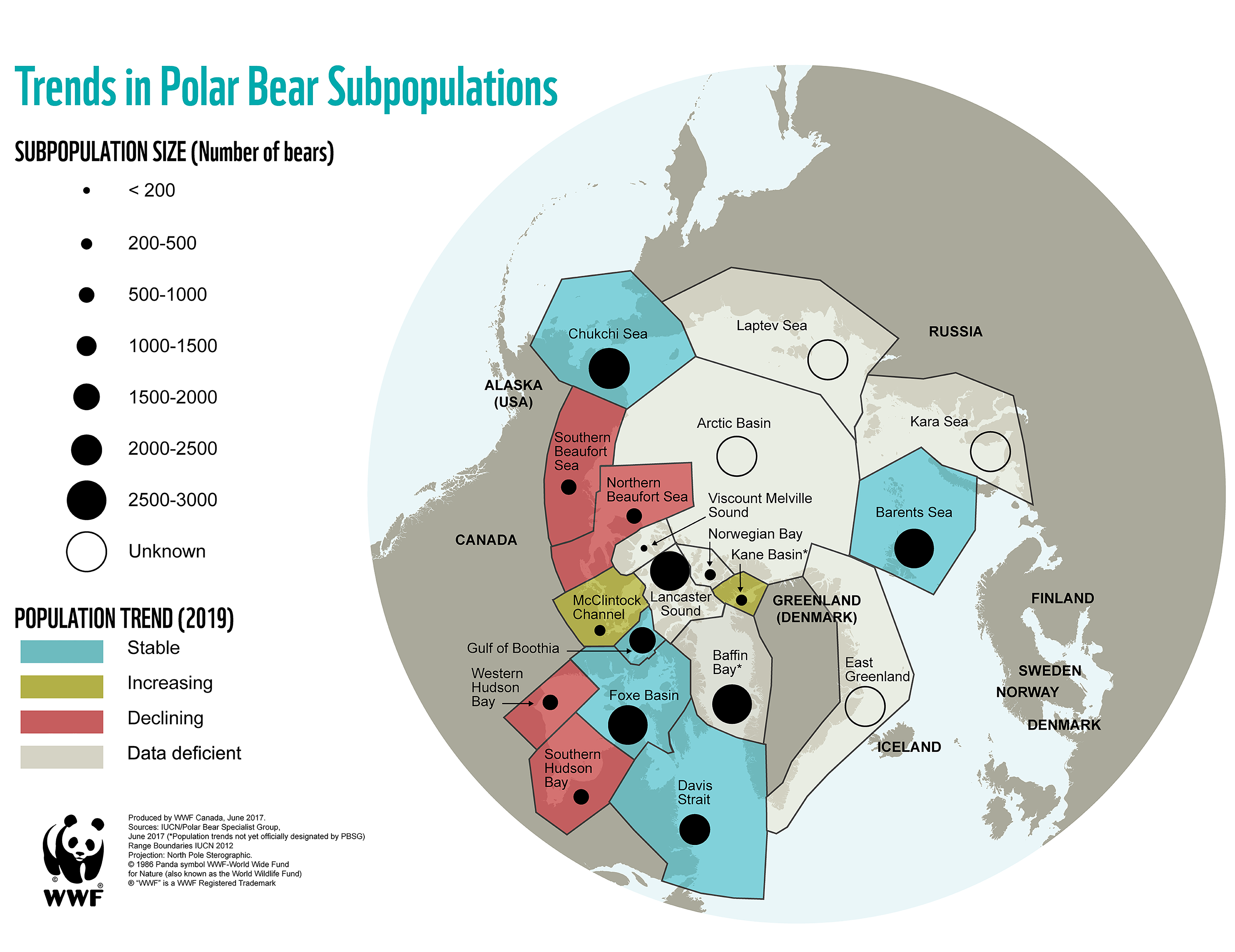
Only two populations are increasing, four are decreasing, and for eight of them, there isn’t enough data to track population changes.
Polar bears are apex predators. I’ve already mentioned that seals are their primary prey, but the FWS’s overview of them includes the fact that they also eat walruses, and even whales that are stranded or are carcasses after being united by orcas or for humans’ subsistence hunting. Per the WWF, polar bears themselves spend around 50% of their time hunting, so any increase in time to find their prey increases their already energy-intensive lifestyle.
The FWS has also described how polar bears survive the cold. They actually have black skin to better absorb heat from the sun. Polar Bears International goes into more depth, adding that they also have two layers of fur and a thick layer of fat, up to around four inches thick, to help insulate from the cold. Their fur is actually hollow, too! It reflects light, making these bears look like they have fluffy white coats. This helps them blend into the snow and ice.
Some other fun facts about them, thanks to the WWF, are that they have three eyelids to withstand the snow, and they’ve also got blue tongues. They have very large paws, around eleven inches in diameter, that let them walk on thin ice and help them swim up to six miles per hour.
One aspect about them that makes it harder for them to survive the change in climate is their slow reproduction. FWS’s overview on them explains that they only give birth to around one to three babies in a litter, and mothers can only give birth when they’re five or six years old. They do make dens like other bears, but only when taking care of a litter!
Imagine the size of these large bears—one of the largest bear species on the planet. Per Polar Bears International, they can get between three and a half and five feet tall at the shoulder, and males can reach up to ten feet tall when standing on their hind legs. Females average about 500 pounds, which is the weight of a pig, or a whale heart! Males average twice that, which is about as heavy as a grand piano. One of the largest male polar bears reported was 1300 pounds, or about as heavy as an entire cow!
Regardless, this gorgeous species is not only an important indicator for the state of the arctic, they’re important for the food chain in their ecosystems, and they’re vital for the lives of indigenous peoples and their cultures, like the Inupiat.