
Emerson Faculty and Student Collaborate on Autism Research Presented at Global Conference
When people think of Emerson, they often picture our strengths in communication, media, arts, and storytelling. What is less widely known is that Emerson is also deeply engaged in scientific research, particularly in the study of human communication. Within the College’s School of Communication, the Department of Communication Sciences and Disorders (CSD) brings together faculty and students who investigate how people understand, produce, and experience language across the lifespan.
Faculty, students, and staff from Emerson’s Facial Affective and Communicative Expressions (FACE) Lab recently traveled to Prague, Czech Republic, to present their latest scientific findings at the annual meeting of the International Society for Autism Research (INSAR) in April, 2026.
INSAR is a premier international autism conference that changes its global host city every year, drawing leading scientists, clinicians, and advocates from around the world to share advancements in autism spectrum research.
Directed by Dr. Ruth Grossman, professor in the Department of Communication Sciences and Disorders (CSD), the FACE Lab at Emerson investigates how autistic and non-autistic individuals produce, perceive, and integrate verbal and nonverbal cues, such as facial expressions and voice prosody, during face-to-face communication.
The FACE Lab was well-represented at this year’s conference by research coordinator Elana Groves, Emerson graduate student Gabriela Garcia ‘26, and Dr. Grossman.
The team shared their latest insights with the international community, with several poster presentations highlighting their ongoing work. At conferences like the INSAR Annual Meeting, a poster presentation is a formal scholarly contribution to an international research conference.
Gabriela Garcia MS ‘26 presented her thesis work on conversational behaviors of autistic children in a poster entitled “Topic Adherence and Its Impact on Conversational Behaviors of Autistic Children.” The goal of the study was to understand how teenagers react when someone breaks social norms by interrupting or acting confusing. Autistic and non-autistic adolescents had a conversation with two research assistants. The two research assistants behaved differently: one always adhered to expectations for conversational discourse. The other consistently violated those expectations by neglecting to introduce new topics, interrupting, and asking difficult and unusual questions.
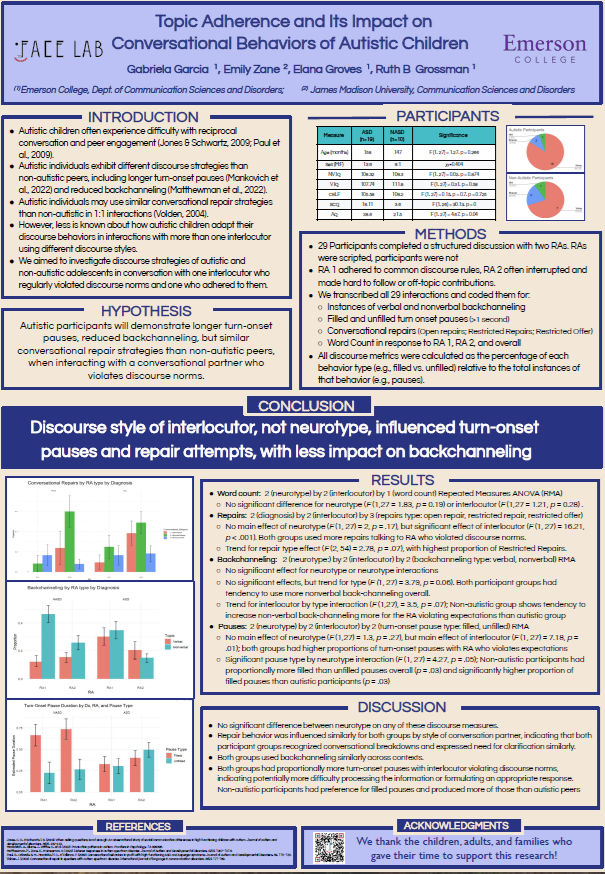
Garcia was interested in learning whether the autistic and non-autistics adolescents would respond differently to these two communicative styles. She measured how participants used verbal and non-verbal listener feedback, (e.g. head nods, or “uhum”) and how long they paused before responding to each research assistant. She also measured whether participants requested clarification during conversations (e.g. “she did what?” or “what did he say?”).
Her findings show that both autistic and non-autistic teenagers adapted to the awkwardness in the exact same way, taking longer pauses to process the confusion and working hard to fix the conversation. The only major difference was that non-autistic teenagers relied heavily on filler words like “um” and “uh” to hold their place while thinking.
Garcia emphasized that these data are important in that they show the importance of conversational context when evaluating autistic and non-autistic language use.
This was the first major conference Garcia attended and she was excited to be surrounded by so many researchers who care about the same questions and populations she cares about. “Attending INSAR as an Emerson student was a very special experience for me,” Garcia said. “It was my first time attending a professional conference, and I was proud to represent both Emerson College as a graduate thesis student and the FACE Lab under Dr. Ruth Grossman. What impressed me most was seeing so many people come together with a shared passion for autism research and advocacy. I learned a tremendous amount about the field from incredibly knowledgeable and accomplished professionals, but I was especially inspired by everyone’s dedication to continuous learning, improving outcomes for autistic individuals, and centering autistic voices and experiences in their work. “
Other presentations by the Emerson contingent included the presentation “Stick or Switch? Does Task Success Affect Strategy Use on a Collaborative Task between Autistic and Non-Autistic Teens” led by Elana Groves, FACE Lab’s Research Coordinator, and professor Ruth Grossman, who were part of a study that included researchers from University of Connecticut, Children’s Hospital of Philadelphia, and Aarhus University (Denmark). This study looked at how pairs of teenagers adjust their communication when playing a collaborative “spot the differences” game. The researchers wanted to see if hitting a roadblock or failing a round would cause the teens to switch up their strategy. Surprisingly, whether the teens succeeded or failed had no impact; they consistently stuck to their initial communication styles, showing that teenagers maintain a stable approach to problem-solving regardless of the outcome.
Groves and Grossman were also part of a second poster presentation, “Strategy Matters: Neurotype, Sex, and Initiation Strategy Effects on Collaborative Task Success.” Diving deeper into the same teenage guessing game, researchers evaluated which communication strategies actually led to a win. They discovered that teams using highly structured planning or interactive, back-and-forth conversation were much more successful than those who just described what they saw. Interestingly, mixed pairs (made up of one autistic and one non-autistic teenager) performed slightly better than pairs of the same neurotype, suggesting that blending different perspectives and communication styles can actually make a team stronger.
Members of the community can explore these research contributions firsthand. All of the INSAR presentations, alongside other current lab initiatives, are available to view on the FACE Lab’s poster website.